Prime Factorization: Understanding Structure Before Scale
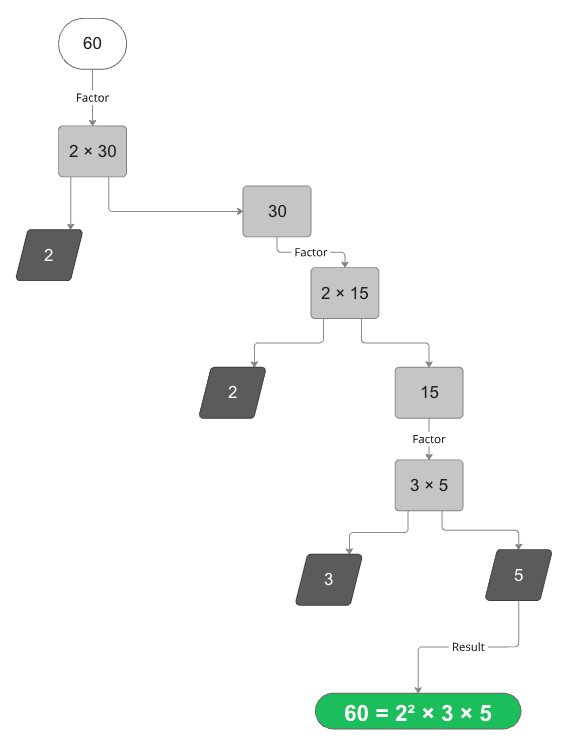
Prime Factorization Method
What is Prime Factorization?
Most of us learn prime factorization as a basic math concept. Take a number and break it down into smaller numbers until you’re left with primes, numbers that cannot be divided further. At first, it feels like a mechanical exercise.
Something you solve, write down, and move on from. But there’s a deeper idea hidden inside it.
Every number has a structure. And that structure determines what you can do with it.
What Prime Factorization Really Means
Prime factorization tells us that any number can be expressed as a combination of its most basic building blocks. And once you know those building blocks, you unlock useful properties:
What the number can be divided into
How it can be grouped
How it aligns with other numbers
How flexible it is in different configurations
It’s not just about breaking something apart. It’s about understanding what’s possible because of how something is built.
Where This Becomes Useful in Real Life
This idea shows up more often than we realize, especially when we need clean structure, efficient division, or alignment.
Splitting Work Evenly
Imagine you have 360 tasks and want to distribute them across machines or people without imbalance.
Prime factorization:
360 = 2³ × 3² × 5
Now you immediately know you can split this cleanly into multiple configurations:
8 groups of 45
9 groups of 40
12 groups of 30
Instead of trial and error, you design the split intentionally.
Choosing Effecient Batch Sizes
Say you’re processing 10,000 records in a data pipeline.
10,000 = 2⁴ × 5⁴
This tells you:
You can create clean batches like 100, 200, 250, 500
You avoid partial or leftover batches
This matters in real systems where inefficiency adds up quickly.
Aligning different cycles
You have:
One job running every 6 hours
Another every 8 hours
Prime factorization:
6 = 2 × 3
8 = 2³
The first time they align is at:
2³ × 3 = 24 hours
This is directly useful when designing:
Data pipelines
Model retraining schedules
System refresh cycles
Designing layouts & grids
If you have 120 items to display:
120 = 2³ × 3 × 5
You can structure layouts like:
10 × 12
8 × 15
6 × 20
Instead of guessing layouts, you choose ones that:
Fit screens better
Look balanced
Planning for scale
Some numbers are easier to scale than others.
Example:
720 = 2⁴ × 3² × 5
This gives you many ways to divide and expand capacity cleanly. In systems design, this matters because:
More factor combinations = more flexibility
Fewer factors = more rigid systems
A simple way to use this
You don’t need to factor everything. Just use it when:
You need to divide something evenly
You want zero leftovers
You are designing systems, batches, or layouts
You need cycles to align
Ask:
“What is this number made of, and what does that allow me to do?”
Why This Matters
Prime factorization is not just about numbers. It’s about structure enabling possibility. Once you understand what something is made of:
You stop guessing
You stop forcing solutions
You start designing with clarity
The Takeaway
Before deciding what to do with something, understand how it’s built. Because structure doesn’t just describe a system. It defines what’s possible within it.
